10-second summary:
- Your first shoe should be a comfortable ‘all rounder’, generally flat or very slightly downturned but supportive of your foot (e.g. stiff).
- Don’t worry too much about rubber or features unless you already know you want to specialise.
- The shoe should be tight, but not painful. Your toes should reach the end of the shoe with little or no dead space.
- Many shoes are now synthetic so won't stretch over time. Leather shoes may stretch about 1/2 size over time.
- It takes around 20 climbs to break shoes in so don’t be disheartened if you experience a little bit of discomfort at the start.
- Shopping around is key to finding the right shoe as is finding a brand that is right for you.
- For your first pair of shoes you should try and get yourself to a shop to try them on, you’ll pay a bit more but you’ll get the support and help to get you the right pair of shoes. Basically you’re taking the risk out.
- A shoe of up to £120 is ideal for a first pair of shoes which will give you mileage on boulders and climbing walls both indoors and outdoors. More money typically buys a more specialised (e.g. for overhangs) rather than better shoe.
Overview
Buying your first pair of climbing shoes can feel tricky - they aren’t your normal pair of street shoes after all. With an array of shapes and sizes and marketed features from a growing number of manufacturers, it can be hard to cut through to what's important - finding a shoe that fits you well but without undue pain and supports your climbing goals for the future. When you’re getting into climbing you don’t want to be in pain so comfort is key.
There is a lot of detail below to help inform you but if you don’t want to wade through it read the first paragraph - it summarises the information and provides guidance for beginners
Types of shoe
Your first shoe should be a comfortable ‘all rounder’, generally flat or very slightly downturned
In very broad terms there are 3 types of shoe:
- The all-rounder - aka the ‘beginners shoe’
- The heavily downturned shoe that you often see boulderers wearing
- The outdoor shoe often with a flat edge that might look like an all-rounder but with a big price tag
The key thing to remember here is that after a certain price point - around £100-£120 shoes tend to become specialised rather than ‘better’. So they get better at a certain thing (overhanging indoor terrain, speed climbing, outdoor crack climbing) rather than providing an all round upgrade in performance.
When you’re starting out, and even after several years of climbing if you’re not looking to specialise in a certain discipline (or have shoes for each) then have an all-rounder, perhaps a more featured ‘intermediate’ shoe is probably all you need. Plenty of climbers wear all round beginner style shoes and can climb very well in them.
Consideration for outdoor shoes are a bit more nuanced (but not different!), shoe designers build different shoes for different types of rock and the terrain they normally feature, specifically the footholds, not for the type of climbing. So the angle or the route, the grippiness of the rock, the size of the holds, how narrow the holds are (think pockets), the length of the routes etc. are all factors. But given we’re talking about your first pair we don’t need to worry about this too much. But its worthwhile being aware of this is its for the different rocks and climbing locations around the world, that designers develop their shoes to perform. Manufacturers are increasingly designing shoes for indoor use as opposed to different rock types and regions these tend to be much softer.
Characteristics / Jargon
If you’re new to climbing, a shoe that is comfortable with laces or velcro and no/little downturn is probably the best option. Don’t worry too much about rubber or features unless you already know you want to specialise
Materials - shoes have various linings from synthetic materials to leather. The key here is stretch: synthetic materials tend not to stretch much, whilst full leather lining can change up to a whole size over the life of the shoe so you may want to take this into account, but probably on your second shoe which you’ll probably want to spend a little more on. BUT be careful of buying a shoe on the assumption that it will stretch as some don’t.
Rubber - most manufacturers have their own brand or rubber or use a 3rd party such as vibram. These typically fall into 3 categories - entry level where durability is key and then they split into a hard compound (such as XS Edge) which resists compression making for a durable rubber which is good for small edges, typically better for heavier climbers, or a softer compound (such as XS Grip 2) which deforms to the surface giving greater grip typically better for a lighter climber. Until you’re worried about these things don’t worry too much about the rubber, BUT be warned if you get a soft rubber and are a bit sloppy with footwork you can burn through this quickly!
Last - is the shape of the shoe. So you can have the same last (fit) but with different rubber on the shoe, different characteristics, etc. The last is the wooden model foot that they use to make the shoe. If you have the same last on a pair that fits your feet, chances are the other shoes will fit too. Not all manufacturers state the shoe last, but some, like Scarpa do.
Closure - covers three areas; laces, velcro of slipper/moccasin (no closure). Laces can provide more adjustment across the foot but typically take longer, velco is quicker but can mean some pressure points from buckles - really it's down to personal preference and how long you’ll be climbing in the shoe (actually climbing not wearing them). Some prefer laces for outdoor shoes as they are on longer. Because you can’t adjust the closure a moccasin probably isn’t the best choice for a first shoe.
Features - this can get complex as each manufacturer tends to have its own name for the same sort of system (for example La Sportiva’s P3 and Scarpa’s Bi-tension). Most of these do add to the shoe, but unless you need it then don’t worry about these when you’re buying your first shoe - they will add cost and in general are just a marketing ploy.
Sole length - The design of the shoe, as well as the length of the sole, can determine how rigid the shoe is in both torsion (twisting or side-to-side) and toe to heel. However, it is typically the sole that will give a clue as to how stiff the shoe is. Stiff shoes - in torsion and toe to heel - will provide more support to the feet as the whole shoe takes the weight of the climber better. This makes them better for longer sessions, the outdoors, edging and also for beginners whose foot hasn’t adapted to the stress of climbing yet. On the other hand, a soft shoe is likely to be more sensitive and allow you to stand on surfaces requiring a lot of ankle flexion, think smearing on tricky volumes or curved holds on indoor boulders. They tend to allow more 'feel' as the shoes adapts to the hold shape. This tends to be harder on the foot and requires a tighter-fitting (smaller) shoe. As a half way, some shoes have a rigid mid-sole, the area under the ball of the foot, which provide some rigidity at the toe giving a balance between edging and smearing.
How can you see which is which? By looking at the sole; if the rubber of the shoe runs the length of the shoe and wraps around the back it’s likely to be stiffer. If the rubber patch is only on the ball of the foot or is split between the heel and ball the shoe will be less rigid. The difference between and soft and mid-soled shoes is harder to spot from the outside but the fold test (below) and a bit of research into the shoe will provide the answer.
The construction of the shoe and the rubber will also play a part but the giveaway tends to be the amount of rubber on the sole of the shoe. You can test the rigidity of the shoe by bending it along its length and by trying to fold the shoe width-wise where the ball of the foot would sit.
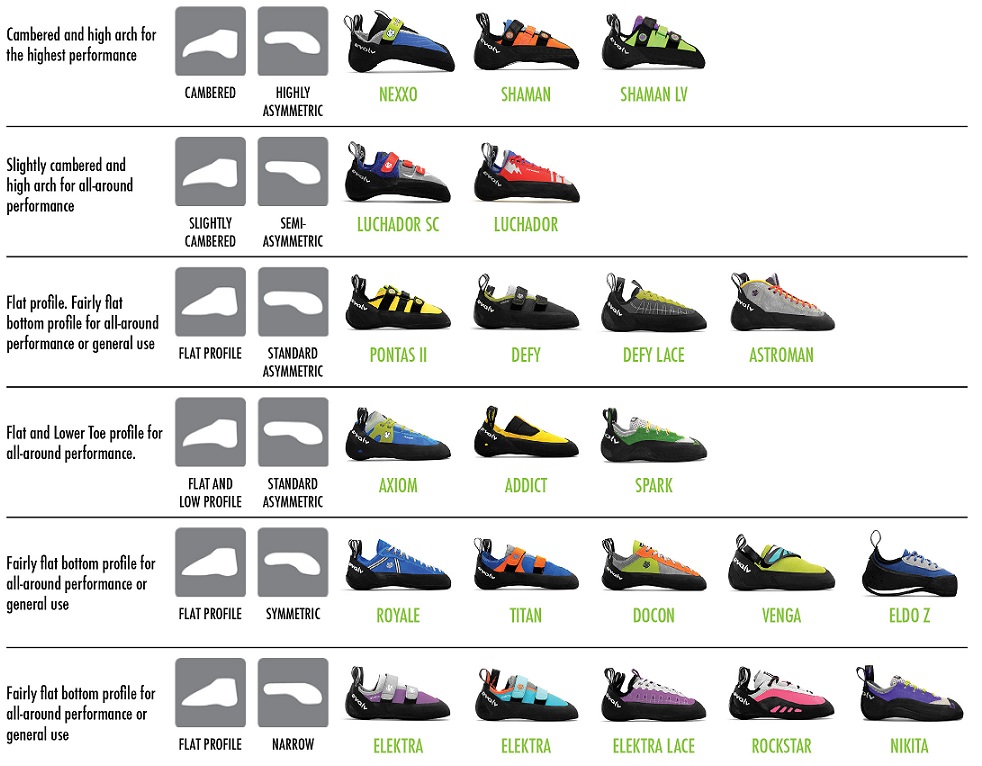
Symmetrical/Asymmetrical - this is of the individual shoe rather than a pair (they are always matched!) Symmetrical means the degree to which the tip/point of the shoe is moved towards the centreline of the shoe - so if you had a longer 4th toe a symmetrical shoe would have the point nearer your 4th toe and would pull the big toe towards the middle. A highly asymmetrical shoe by contrast will move the little toes towards the big toe more.
Sizing & fit
You want a shoe that fits snuggly in length and also across the whole foot but with little to no pain, consider not just size, but volume (girth of the foot) too
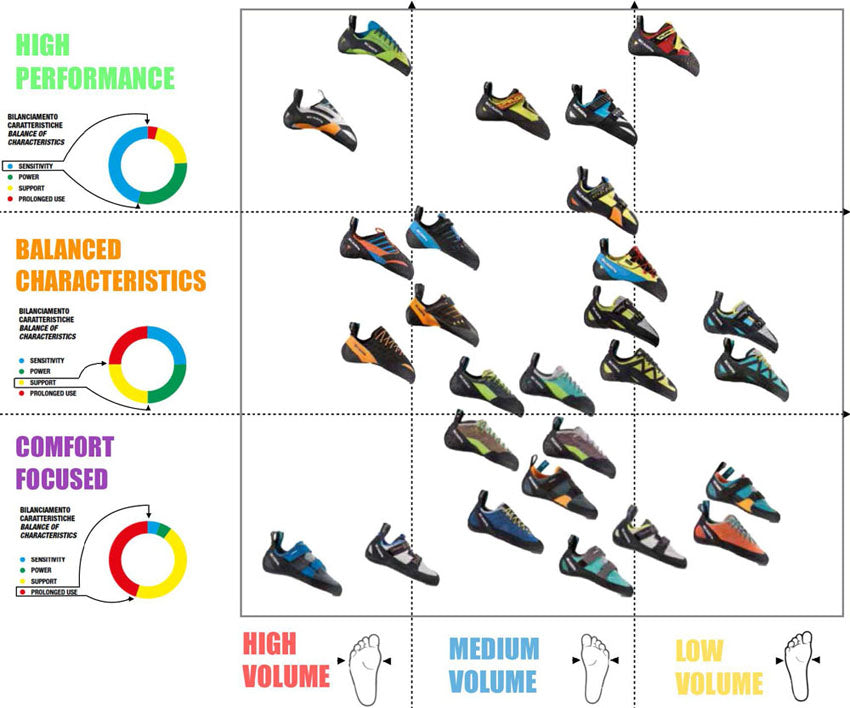
There are three key things to consider: size (length) and width (the width across the knuckle area) and volume (the girth of the foot especially behind the knuckle area) and how these interact with tightness vs. pain! There is more to it than that but those are the two most important considerations.
Historically shoes were sized in the same way as normal shoe sizes meaning you’d have to down size 1-2 size to find your fit, these days sizing is typically adjusted so your street size shoe should be a rough approximation of your rock shoe size. But it is well worth trying on a range of different sizes to work out which is best. It can be a bit harder to size across brands so take this into consideration and a visit back to the shop may be sensible.
Width and to a certain extent volume tends to be the missing ingredient but if the shoe is too narrow it will mash your toe knuckles (phalanges) together resulting in pain, especially when loaded. Or, if they are two big, they can result in the shoe bagging out which means the foot can move around again leading to pain and poor shoe performance as the forefoot can move up in the shoe. This is why you can find a shoe which is the perfect length but as soon as you weight your foot it results in a lot of pain.
Manufacturers tend not to be so good at advertising or explaining the width of each shoe but they will all have different widths and volumes depending on the last (template) of the shoe. Refer to some of the links at the bottom of this to find the details for manufacturers that I could find. Some like, Scarpa are getting good at clearly advertising the width of the shoe.
Volume also tends to be confused further by some brands having two overall fits of shoe for bulkier or slimmer feet which are unhelpfully labelled ‘mens’ and ‘womens’. Thankfully the industry is starting to use the term LV (low volume) to denote a slimmer foot and more LV shoes are coming out for well known and loved shoes.
Once you know your size, width and volume you can more easily identify shoes from the same manufacturer that are likely to fit you.
So how do these relate to pain? Rock shoes need to be tight to work effectively, in basic terms the shoe needs to push your toes to the front of the shoe to ensure the gap between the edge of the shoe and your toe is eliminated. Most shoes do this by the heel section pushing your foot forwards but can also do this via twisting the toe box, curling downwards or even with inserts to help the toes bend. This is the opposite to all other shoe sizing and can result in people fitting shoes too tightly. The key here is that the toes should be against the front of the shoe and either flat or slightly curled over. Any more than this tends to be a recipe for pain with no gain and if worn for too long damage to the foot.
It is worthwhile noting the downturn and asymmetry of the shoe (how much the shoe twists your foot to focus power onto the toes) means that some shoes are more inherently discomforting than others. Those with a high downturn and a performance focus will typically demand some pain in exchange for good performance! Shoes that are stiffer tend to be more forgiving with sizing whereas soft shoes tend to have to be a tighter fit to work.
A note on pain - shoes that crush the toes together can result in ongoing pain once the shoes are off. If this is the case you really need to re-evaluate your ongoing use of those shoes. Wearing shoes that create ongoing pain such as metatarsalgia or Morton’s Neuroma can have long term consequences for your feet.
Breaking in
It takes around 20 climbs to break shoes in so don’t be disheartened if you experience a little bit of discomfort
Not normally considered straight after sizing and fit but it is worthwhile bearing in mind that shoes typically take 20 climbs to break in fully so the challenge is to judge whether a shoe is going to be painful after this period. If they are painful when you’re not standing on anything they will probably hurt a load more when you stand on a small edge!
Typically once you’ve started to use your shoes on the wall shops won’t take the shoes back so be careful if this is a concern. There are various videos on the web showing different ways of fitting your shoes such as soaking them or heating them, I’ve not tried this, but bear in mind that the materials used in construction are heat sensitive so this may also damage your shoe. If in doubt, follow the manufacturer's guidance!
Brands and how they affect size
Shopping around is key to finding the right shoe as is finding a brand that is right for you
This is very much down to personal experience but certain brands seem to suit certain feet better. This may just be down to most people not having tried a huge range of shoes from all the brands but over time people tend to feel that a certain brand fits their foot better - beyond the scope of the normal size, width and shape characteristics so this may be smaller heels or shaped better for the shape of their forefoot and toes. The point here is to try a range of different shoes from different brands to see if one suits you better.
Trying shoes
If it's your first pair of shoes try and go to a shop and get some help with fitting your shoes
For your first pair of shoes, and often for your next pair of more specialist shoes (and probably for every new climbing shoe you buy) it can be very worthwhile going into a shop and getting the support of one of the assistants there. They are typically trained in how to fit shoes, so whilst it's helpful to have done your own research and being as informed as you can, they will be an excellent guide and you’ll also have the advantage of trying on a wide range of different shoes and brands which is vital. You’re also not obligated to purchase if you don’t find something you want.
You can do this with online purchases but it can be hit-and-miss sending shoes back. This can add up to quite a bit in both postage costs and especially time so think carefully before you splash out on ebay or an online store.
Where to buy
For your first pair of shoes you should try and get yourself to a shop to try them on, you’ll pay a bit more but you’ll get the support and help to get you the right pair of shoes. Basically you’re taking the risk out
- Shops - for your first pair of shoes this is pretty much essential. They tend to cost a bit more but bear in mind the ‘cost’ of returning shoes that don’t fit!
- Online - you’ll typically find better prices on the internet than in shops but you really need to know the shoe and size you are buying and have a high level of confidence that the shoe will be right for you. If not you can waste a lot of time and potentially money sending them back.
- eBay/2nd hand - possibly the cheapest route but the one open to the greatest level of uncertainty: what shape is the shoe in? How much has it stretched, is there damage? What size is the shoe actually? How much life is there left in the shoe (e.g. how much of the sole is left?). There are a lot of unknowns!
Unfortunately climbing walls don’t always carry a wide range of shoes and there is a lack of specialist climbing shops, especially in the south of England, so going to the larger outdoor shops can be best such as the likes of Go Outdoors can be helpful. Just check before that they actually sell climbing shoes.
Cost
A shoe of up to £120 is ideal for a first pair of shoes which will give you mileage on boulders and climbing walls both indoors and outdoors
Shoes are generally getting more expensive with the £100 barrier being smashed about a decade ago and showing no signs of stopping (nearing £200!). At the same time shoes are also getting cheaper with recent new entrants such as SImond by Decathlon which provide all the basics for a beginner without the brand. Whilst it's generally true that you get what you pay for, bear in mind that shoes generally become more specialist over a certain price point (about £120). There is no ‘king of shoes’ that is also a ‘jack of all trades’. Also there is no best all round shoe - the best shoe is the one that fits you well.
Also bear in mind that whilst some shoes may cost up to £170 you can, if you don’t wear the shoe out, you can get them resoled around 3-4 times. This makes shoes arguably cheaper over their lifetime vs. a lower-cost shoe which is discarded after the sole wears out.
Common mistakes
-
- Buying on colour/look - colour is important… but make sure you try them on first! There are more important things to prioritise!
- Going for the expensive ones - expensive does not equal better, it generally equals more specialised You could find your expensive specialist shoes pretty terrible at some pretty basic things!
- Ordering online - online is a good route, once you know enough about shoes to minimise the risk of getting it wrong, even then you could find yourself sending back a number of shoes!
- Getting them too tight - if your shoes are painful you won’t want to put them on, if you don’t want to put them on at best you’ve wasted your money and at worst you might not want to climb!
- Wearing shoes throughout a session - rock shoes are designed for climbing in and that's it, they aren’t designed to stand around belaying in, walking in, sitting in, or anything other than climbing. Put your shoes on, climb, then take them off. Even if they’re ‘ok’ you foot will still develop pain over the time diminishing your performance as the session goes on. Your rock shoes are tools, not footwear!
- I’ll just slip off my shoes and stand on the heels - not a great idea. This destroys the heel of the shoe which is essential to keep the shoe fitting well and the sole flat when you’re climbing.
- Leaving shoes in your bag for a week - even if you wear socks you’ll still probably sweat into your shoes. If you then leave them in a bag and they can’t dry. This is a great environment for the growth of fungus or mold. Not great but this will result in a hell of a hard to remove stink! Make sure you air your shoes and consider using that something will dry them out - boot bananas or talcum powder work well
Links to outdoor shops we’ve used
https://www.absolute-snow.co.uk/ - good deals
https://www.outside.co.uk/ - great shop in Hathersage too
https://www.trekkinn.com/ - EU based but has some great deals
https://www.trekitt.co.uk/ - EU based but has some great deals
https://www.bergzeit.co.uk/ - EU based but has some great deals
www.climbers-shop.com - Based in wales
https://www.v12outdoor.com/ - Often have good deals on cosmetic seconds
https://www.epictv.com/ - also do lots of useful guides and reviews
Its worthwhile joining the BMC as you can get good discounts on many places online but even more instore
Links to shoe sizing charts
https://www.scarpa.co.uk/blog/wp-content/uploads/2018/09/volume-and-characteristics.jpg
https://www.scarpa.co.uk/blog/wp-content/uploads/2018/09/suggested-uses.jpeg
https://world.scarpa.com/page/climbing-collection-structure
https://egress.storeden.net/gallery/5fce15a900f220cf8768b18f
https://www.wildernessshop.com.au/blogs/wilderness-blog/choosing-rock-climbing-shoes
https://i.pinimg.com/originals/0a/7a/4a/0a7a4a0263af7dc3d532cd340eaaedfa.jpg
https://www.lasportiva.com/media/landing_pages/ClimbingChartmobilechart.jpg
https://www.lasportiva.com/media/size_chart/chart_ClimbingShoes.jpg
Robbie’s guides:
https://www.youtube.com/watch?v=UtBMhL-hfcI&list=PLO_R6wtvhsFydjTnaaTqx6R7rC1zGJe4g&index=2&t=626s
https://www.youtube.com/watch?app=desktop&v=jLiTtiTSYp4 - Outdoor
https://www.youtube.com/watch?v=66G-O0ljzo0&list=PLO_R6wtvhsFydjTnaaTqx6R7rC1zGJe4g&index=4 - Indoor